
We have been living here since 2004. We mapped the two major cities of the country when tourist maps did not yet exist. We saw Pub Street rise from the ground, Koh Rong transition from a fishing village to the tropical island reference, and Angkor adopt a modern ticketing system. Here is the itinerary we recommend for ten days, which we also follow when our friends from Europe arrive.
Before You Leave: Four Things to Arrange
Preparing for Cambodia is straightforward, provided you don’t miss the four essential prerequisites. Allow for a week's leeway, no more.
The Visa. The official Tourist e-Visa (Visa T) is obtained online at evisa.gov.kh for USD 30. It is single entry, allows a stay of 1 month, and is valid for 3 months from the date of issue. Allow three business days, a digital passport photo, and a passport with more than 6 months of validity remaining at entry. Some nationalities are exempt. Our detailed guide on the Cambodia visa. Beware of intermediary sites that charge double.
Travel Insurance. Non-negotiable. The decent private hospitals in Phnom Penh and Siem Reap charge in dollars and require a bank guarantee before treatment. We recommend Chapka for French travelers: coverage for repatriation, medical expenses, and luggage, with online subscription in 5 minutes.
Coverage for 90 days, medical expenses up to €1 million, repatriation, and direct coverage with the clinics in Phnom Penh and Siem Reap that we know.
The eSIM. Cambodia has excellent 4G coverage, including in Angkor and on Koh Rong. There’s no need to struggle with local SIM cards at the airport: install an eSIM before departure, and you’ll arrive connected. An eSIM plan of 5 GB for around €11 is more than enough for 10 days — see our eSIM guide.
Flights. Few direct long-haul routes to Cambodia: most travelers connect through Bangkok, Kuala Lumpur, Singapore, Doha, or a major East Asian hub depending on where they start. Plan for 12 to 20 hours door-to-door and a flight budget that varies widely by origin. Our flights and transport guide to reach Cambodia. For this itinerary, prefer an open-jaw ticket: arrive in Siem Reap, depart from Phnom Penh or Sihanoukville.
The itinerary at a glance
The guiding idea: travel down the country from northwest to south. Arrive through the temples, breathe in the capital, descend towards pepper and the river, and end on the sand.
- Days 1 to 4 — Siem Reap and Angkor (4 nights)
- Days 5 and 6 — Phnom Penh (2 nights)
- Day 7 — Kampot (1 night)
- Day 8 — Kep in the morning, crossing to the islands right after
- Days 8 to 10 — Koh Rong Sanloem (2 nights)
A piece of advice we repeat every time: do not underestimate the time in Siem Reap. Three days of visits and four nights on-site is the right formula to admire Angkor at your own pace — it fits exactly with the three-day pass, which remains the best pricing option.
Landing in Siem Reap, settling in, first night
Siem Reap International Airport (SAI) moved in 2023 to 50 kilometers southeast of the city. There are no longer taxis lined up at baggage claim, which is the first surprise. Expect a 45-minute journey and 30 to 35 USD to reach downtown by official taxi.
Our advice: book the transfer before departure. After a 12-hour flight, you don’t want to negotiate a fare in riels at 11 PM. Welcome Pickups sends an English-speaking driver, with fresh water and a cool towel in the car — it’s the kind of detail that changes the entry experience.
Affiliate link: Easy Cambodia earns a commission if you book through this link, at no extra cost to you. Learn more
For the first night, we prefer the area between the river and Pub Street — that’s where everything is within walking distance. Our favorites: Jaya House Riverpark (150 € per night, quiet boutique hotel by the water), Shinta Mani Shack (Bill Bensley design, excellent value), or, more modestly, Onederz Siem Reap (design hostel for under 20 € per night).
Our selection of personally tested hotels, filterable by budget and area.
In the evening, a light dinner. Malis offers the best contemporary Khmer cuisine in the city if you still have the energy to go out. Otherwise, a simple amok with fish or a lok lak with beef on any terrace of Pub Street will do. We recommend going to bed early: tomorrow, wake-up at 4:30 AM.
Angkor Wat at sunrise and small circuit
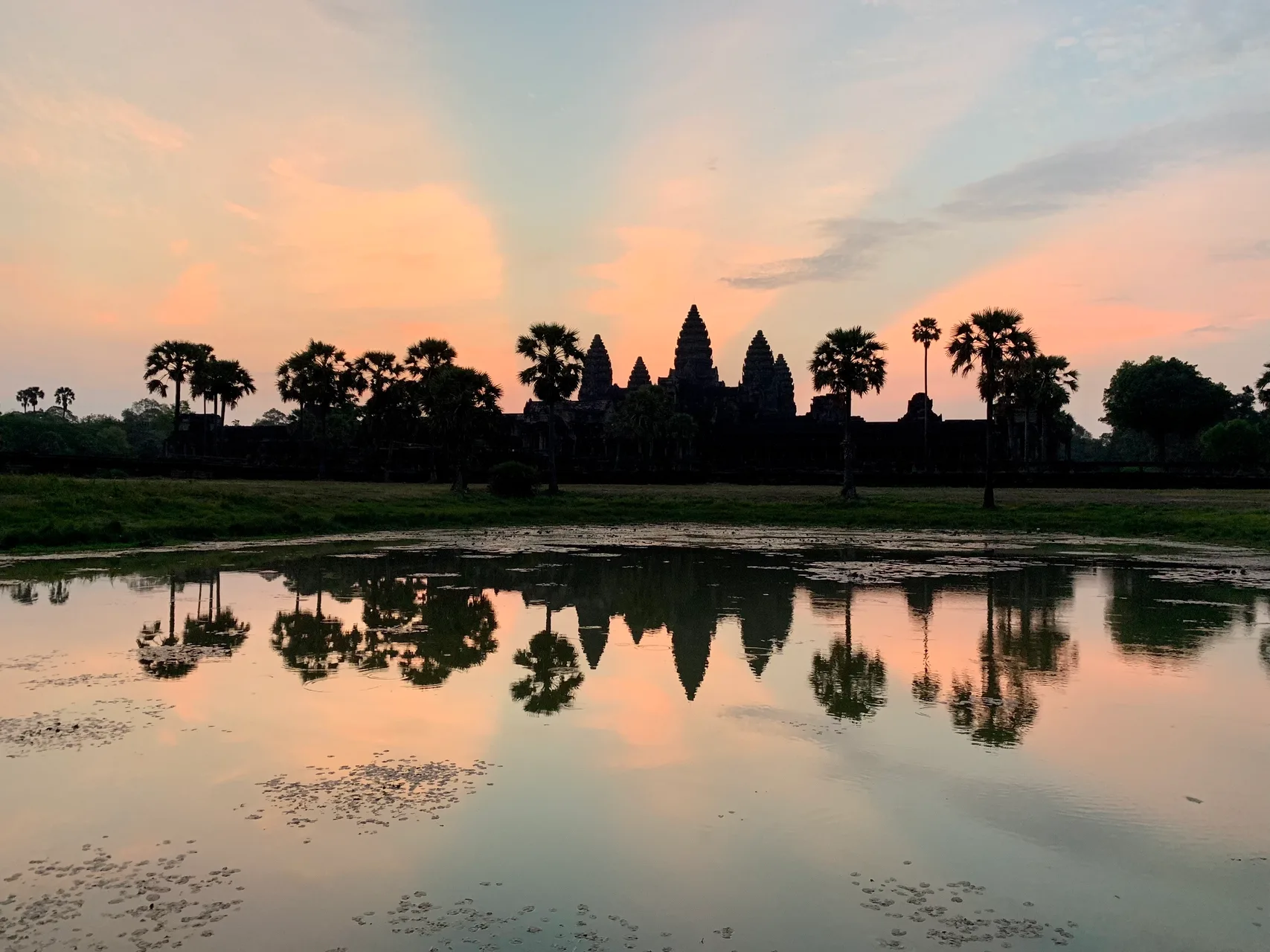
The small circuit is the short loop of Angkor, about twenty kilometers connecting the major monuments. It’s the visit for the first day. Start with the sunrise in front of Angkor Wat — yes, it’s the postcard image, but the pink light resting on the five towers is a moment to be experienced in silence.
A French-speaking guide with a private tuk-tuk for the day costs around 40 to 50 €. It’s worth the investment for the first day: without a guide, you see stones; with a guide, you read a civilization. From the second day, you can settle for just a tuk-tuk if you’ve done some research.
Pick-up at the hotel at 4:30 AM, entrance ticket included, breakfast on-site, qualified French-speaking guide. 5 hours total.
After sunrise, breakfast on-site then the classic loop: Angkor Thom through the south gate (notice the faces of gods and demons pulling the sacred serpent), the Bayon with its fifty-four face towers, the Baphuon, the Terrace of the Elephants. Lunch stop at one of the restaurants north of Angkor Thom — avoid those too close to the temples, prices double there.
In the afternoon, head to Ta Prohm. This is the temple of roots, the one that Angelina Jolie made famous in Tomb Raider. The silk cotton trees have embraced the stones for eight centuries. Go between 2 PM and 3:30 PM: the light filtering through the foliage is remarkable, and the Japanese tourist buses from the morning have left.
Return to the hotel around 5 PM, pool, Khmer massage for 8 USD in any salon on Pub Street, quiet dinner. You’ll be exhausted, which is normal.
Grand circuit of Angkor and Phare Circus in the evening
The grand circuit of Angkor is 26 km and covers the more distant but often quieter temples: Preah Khan, Neak Pean, Ta Som, East Mebon, and Pre Rup. Depart later (7 AM, not 4:30 AM), slower pace, fewer crowds. It’s the day we prefer and the one we often remember the best.
Full day with private tuk-tuk, French-speaking guide, water and refreshing towels. Less crowded temples, relaxed pace.
Return to Siem Reap in the late afternoon. Shower, light dinner, then head to Phare, the Cambodian Circus. It’s one of the most beautiful evenings you can spend in Cambodia: a contemporary circus from an NGO that trains underprivileged youth for free. 1 hour and 15 minutes show, impressive technique, modern scenography, story told of today’s Cambodia. It has nothing to do with the folkloric shows found elsewhere. Reservation is essential, it fills up quickly.
Contemporary circus show by young Khmer artists. Duration 1 hour and 15 minutes, shows at 8 PM.
Banteay Srei, floating village of Tonlé Sap
Last day in Siem Reap, and the most varied. In the morning, head to Banteay Srei, "the citadel of women", 35 km to the north. It’s the smallest major temple in the Angkor site and, without hesitation, the most beautiful. Pink sandstone, sculptures of unparalleled finesse, human scale. You spend an hour there, and that’s enough.
On the way back, optional stop at Kbal Spean, the river of a thousand lingas — sculptures in the riverbed itself, in the heart of the forest. Expect a 45-minute walk from the parking area.
In the afternoon, a complete change of scenery: Kampong Phluk, on Tonlé Sap lake. It’s the most authentic floating village in the area, one hour by road and 20 minutes by boat. Stilt houses 6 meters high in the dry season, submerged halfway in the monsoon. We glide between the wooden houses, children wave, and at the tip, we cross the flooded forest in a small rowboat.
Transfer included from Siem Reap, local boat, rowboat in the flooded forest, French-speaking guide available.
In the evening, prepare for departure to Phnom Penh. Two options to reach the capital: Giant Ibis day bus (6 hours, 15 USD, European comfort, wifi on board), departing at 7:45 AM or 12:15 PM, or domestic flight (45 minutes, 95 to 130 USD, Cambodia Angkor Air). Unless pressed for time, we recommend the bus: the landscape between Siem Reap and Phnom Penh is interesting, you better understand the scale of the country. Book on 12Go, the only platform that aggregates local transport.
Air-conditioned buses, wifi, snacks. Departure from the bus station or pick-up at the hotel depending on the company.
The morning bus arrives around 2 PM in Phnom Penh, allowing you to enjoy the afternoon. So we leave the next morning.
Memory duty and Kanika cruise at sunset
Morning bus from Siem Reap, arrival in Phnom Penh around 2 PM. Drop off your luggage at the hotel — we recommend the Royal Palace area or BKK1 for a first time. Then it’s time for the most difficult part of the itinerary: visiting the S-21 prison (Tuol Sleng) and the Choeung Ek memorial, the "Killing Fields".
It’s hard, to be honest. But you cannot claim to understand contemporary Cambodia without going through there. Tuol Sleng, a former high school turned prison and torture center by the Khmer Rouge, is now a museum. The French audio guide is remarkable, moving, and precise. Choeung Ek, 17 km south of the city, is the site where victims were taken and then executed — the memorial is a stupa containing over 8,000 skulls.
Visit in order: Tuol Sleng first (context), Choeung Ek next (remembrance). Children under 12 are not suited for these sites — arrange for a babysitter or skip this step.
Guided tour of both sites, French audio guide included, air-conditioned transport round trip. 5 hours.
At the end of the afternoon, we return to the hotel, change, and move on to something radically different: the sunset cruise on the Kanika boat. It’s one of the tours our team has operated directly since 2010. We board at Sisowath quay at 5 PM, navigate on the Tonlé Sap and then the Mekong, watching Phnom Penh light up from the water, a cocktail in hand on the upper deck. Duration 1 hour and 20 minutes — exactly the breath of fresh air needed after a difficult day. For those who want to extend the evening, we continue directly with dinner on board: same boat, same seats on the deck, the river at 360°.
Our own boat — 80 minutes on the Mekong at sunset, cocktail on the upper deck. Dinner option on board afterward, to extend the evening without leaving the river.
For those who won’t have dinner on board, the BKK1 area takes over — street 308 or street 240 align the best addresses in the city, from Khmer bistro to contemporary French cuisine.
Phnom Penh Heritage Tour, Royal Palace and markets
Second day in Phnom Penh, radically lighter than the previous day. In the morning: the Phnom Penh Heritage Tour by electric bus. It’s a circuit our team set up in 2019 to read the city differently. Nineteen stops, twenty-two sites, multilingual audio-video commentary (French, English, Khmer, Chinese, Thai, Vietnamese), from the original fishing village to the Art Deco villas of the 30s, passing by the Royal Palace, the central market, and places not usually seen: old colonial banks, first cinemas, the memory of the Khmer Rouge also in the discreet background.
Our own circuit. 19 stops, 22 sites, multilingual audio-video (French, English, Khmer, Chinese, Thai, Vietnamese), silent bus. Departure every hour from the Royal Palace.
Quick lunch at the central market or the Russian market — in our opinion, the Russian one is more authentic, less touristy, that’s where we go ourselves. Try the num banh chok, rice noodles with green curry that we have for breakfast or lunch depending on the craving.
In the afternoon, visit the Royal Palace and the adjoining Silver Pagoda (entrance 10 USD, decent attire required — pants and shoulders covered). Floors tiled with solid silver, Emerald Buddha, royal throne: expect to spend 1 hour and 30 minutes on-site. Just a stone's throw away, the National Museum houses the finest collection of pre-Angkorian and Angkorian Khmer art in the world (10 USD, 1 hour is enough).
Dinner in the BKK1 area, street 308 or street 240 — from Khmer bistro to contemporary French cuisine. We return early: tomorrow, we head to Kampot.
Route to Kampot: pepper and river
Early departure for Kampot. Bus or minivan in 3 hours and 30 minutes, about 9 USD. Private transfers cost around 70 USD for the car, more comfortable for three or four people. Arrival in the early afternoon.
Bus, minivan, or private car. Comparison on one screen on 12Go.
Drop off your luggage at a guesthouse by the river: Rikitikitavi (nice terrace, refined cuisine), Ganesha Eco-lodge (bungalows in nature 10 minutes from the center) or Old Cinema if you prefer the city center. Kampot has a different rhythm — pepper, river, Bokor National Park looming above.
Early afternoon, head to La Plantation, a French estate 30 minutes from the center, open to the public, free guided tour at 1 PM and 3 PM. Learn all about the three colors of Kampot IGP pepper (green, black, red), taste, and buy in reasonable quantities to take home (the red pepper is the rarest, 15 € for 50 g). The cultivation of pepper here is still done in agroforestry, on vines, without chemical inputs.
In the late afternoon, sunset cruise on the Praek Tuek Chhu river. Small wooden boat, three hours, we pass under the monkeys sleeping in the trees, see the stilt houses, and end with the fireflies swimming at nightfall — depending on the season, the banks illuminate. Expect 10 to 15 USD per person.
La Plantation in the morning, sunset cruise in the late afternoon. The perfect duo to understand Kampot.
Dinner by the water at Greenhouse or Tertulia. Go to bed early — tomorrow, departure for the islands.
Blue crab from Kep and crossing to Koh Rong Sanloem
In the morning, a 30-minute drive to Kep, the old-fashioned seaside resort from the 60s that is slowly being renovated. We go directly to the crab market. It’s there, on the waterfront, that we eat blue crab with Kampot green pepper — literally caught in front of you in the cages submerged under the walkway. 12 USD per dish, sublime.
Short walk in Kep National Park (entrance 1 USD, 8 km loop) if the weather allows, then transit to the port of Sihanoukville (2 hours by minivan, about 12 USD). We don’t linger in Sihanoukville: the city has changed a lot with the arrival of Chinese casinos, it’s not a destination we recommend for sleeping. We head straight to Serendipity port to board the fast ferry at 1 PM or 4 PM to Koh Rong Sanloem.
Minivan Kep → Sihanoukville (2 hours, 12 USD) then fast ferry Sihanoukville → Saracen Bay (45 minutes, 25 USD round trip).
After a 45-minute crossing, the scenery changes completely. Koh Rong Sanloem is the smaller of the two major islands in the gulf, the most preserved, where you come to relax rather than party — the opposite of Koh Rong the big one. We land at Saracen Bay, the large bay: 2 km of sand so fine it squeaks underfoot.
We stay on the beach, in bungalows with our feet in the water. Our favorites: Sol Beach Resort (mid-range, the cuisine is remarkable), The One Resort (higher-end, infinity pool on the sand), Saracen Bay Resort (good value), or M'Pai Bay Village (hostel in the north, backpacker vibe, bungalows starting at 15 USD).
Beachfront bungalows, eco-lodges in the jungle. Advance reservation in high season (December-February).
Dinner by the water, barefoot in the sand. Night falls early in the tropics — we enjoy the silence.
Island day: lounging and bioluminescent plankton
A full vacation day. We do nothing, that’s the idea. Breakfast by the sea, swimming, napping in a hammock, reading. The more active will go on a island tour by boat (20-25 USD for the day, masks and snorkels provided) to discover the inaccessible coves on foot and dive on small reefs.
Another option: coastal walk to Lazy Beach, on the west coast. 40 minutes through the inner jungle, and you emerge on a nearly isolated cove with almost golden sand. Fishermen serve the morning's catch around noon, and it’s one of the most beautiful sunsets in the country. Return by the same path before nightfall, or by boat-taxi from the small pier.
In the evening, a boat outing to see the bioluminescent plankton. Departure around 8 PM after nightfall, 30 minutes of navigation to a sheltered cove, and we swim in complete darkness — the water lights up with the slightest movement. It’s the experience everyone remembers after returning.
2-hour boat outing after nightfall, small group, mask and snorkel provided.
Last morning on the island and return transfer
Sleep in, breakfast by the sea, last swim. Depending on your international flight schedule, fast ferry to Sihanoukville at 9 AM, 10:30 AM, or 1 PM (45 minutes, 25 USD round trip), then transfer to Phnom Penh: 3 hours by minivan (about 12 USD) or domestic flight Sihanoukville → Phnom Penh (35 minutes, 80 USD).
Allow at least 6 hours of total margin between the island and your international flight. Ferries can be canceled in monsoon, the road can get congested before national holidays. Better to spend one last night in Phnom Penh than to miss your flight.
Do not leave on the same day as your long-haul flight if you can avoid it. An extra night in Phnom Penh at the end of the trip allows you to decompress, do some last-minute shopping at the Russian market (silks, pepper, silver), and arrive at the airport stress-free.
Affiliate link: Easy Cambodia earns a commission if you book through this link, at no extra cost to you. Learn more
Budget: how much do we start with?
Cambodia is one of the most accessible destinations in Southeast Asia — and one of the most flexible. The same island, the same city, the same temples welcome a hostel student at 15 USD a night and a palace client at 1,500 USD. Here are the tiers, on the ground, excluding international flights and per person.
Backpacker version — starting from €450 for 10 days
Hostels like Onederz, Mad Monkey, or M'Pai Bay Village at 12-18 USD a night, meals at the market (2-4 USD per dish), shared buses and tuk-tuks. 3-day Angkor Pass included (62 USD). This option remains high-quality in Cambodia: hostels are often very well designed, pool included.
Comfort version — starting from €800 for 10 days
This is our default recommendation. Boutique hotels at 40-80 € a night (and you can find gems: pools, patios, refined design — places that a Greek island would charge triple for), mid-range restaurants, private tuk-tuks for Angkor, targeted guided activities. Cambodia is fantastic at this budget level, probably the best value for money in Asia.
Premium version — starting from €1,500 for 10 days
4 or 5-star hotels (Jaya House Riverpark, Shinta Mani Shack, Rosewood Phnom Penh), domestic flights instead of buses, private French-speaking guides, tailor-made experiences.
Palace version — no ceiling
For those who want a dazzling Cambodia: the Zannier Phum Baitang in Siem Reap — stilted wooden villas in the middle of rice fields, undoubtedly the most beautiful hotel in Southeast Asia, and the place where Angelina Jolie stayed during the filming of First They Killed My Father. On the island side, Song Saa Private Island or Alila Villas Koh Russey offer a Maldivian experience. Budget: starting from 500 € a night, with no ceiling.
There is not one budget for Cambodia, there are as many as there are travelers. The beauty of the country is that the same temples, the same beaches, the same cuisine welcome you whether you pay 15 USD or 500 USD a night. We recommend setting the budget to your usual comfort level, without trying to upgrade just because "it's cheap."
What is the best season for this itinerary?
November to February remains the ideal window. Clear skies, temperatures around 28-32 °C, manageable humidity, calm sea on Koh Rong. It is the high tourist season, so book in advance, especially around Christmas and New Year.
March to May: possible but stifling (40 °C in Phnom Penh and Angkor in April). Plan to wake up at dawn, take a nap, and book a hotel with a pool.
June to October: monsoon. Contrary to popular belief, it is one of the most beautiful seasons for Angkor — the rains are short, the landscapes vibrant, the crowds absent. The only real issue: crossings to the islands may be canceled, especially in September. If you are traveling during this period, keep some flexibility at the end of your journey.
Variants according to your profile
Family version with children
Replace Tuol Sleng and Choeung Ek on day 5 with the Royal Palace and the National Museum. Keep the small Angkor circuit (day 2) but skip the sunrise — too early for the little ones. Add a day of elephants in the forest in Mondulkiri if you have 12 days instead of 10. Remove the bioluminescent plankton if the children are under 8 years old.
Couple and honeymoon version
Opt for character hotels: Amansara in Siem Reap (or Zannier Phum Baitang for the big game), Rosewood in Phnom Penh, Jaya Inn in Kampot, Song Saa Private Island or Alila Villas Koh Russey on the islands. Prefer domestic flights to buses. Starting from €2,000 per person on the ground, with no ceiling.
Backpacker version, small budget
Hostels (Onederz, Mad Monkey) at 12-18 USD a night. Meals at the market (2-4 USD per dish). Local transport only. No private guides: shared guide at the Angkor temple (grouped on-site). Starting from €450 per person on the ground.
This article contains affiliate links to GetYourGuide, Booking, 12Go, Welcome Pickups, Chapka. When you book through these links, we receive a commission at no extra cost to you, which allows us to write free and detailed guides like this one. We only recommend activities and services that we have personally experienced or that our clients have positively reported over several years. The two tours Kanika Cruise and Phnom Penh Heritage Tour by electric bus are operated by our team.
FAQ
Yes, it's the ideal format for a first discovery. You can cover Angkor, Phnom Penh, the southern coast, and an island without rushing. Below 8 days, you have to sacrifice either the islands or Phnom Penh. Beyond 12 days, you can add Battambang or Mondulkiri.
Take the bus if you have the time. Six hours on a road that reveals the country. The plane if you have less than 9 days — it saves you half a day. Both are safe; we have personally used Giant Ibis for over ten years.
Yes, and it is common. Enter through Bangkok, exit through Ho Chi Minh, or vice versa. The land border at Poipet (Bangkok side) is passable but tedious; ASEAN internal flights are very affordable. Our recommendation: prioritize flying between capitals, keep the bus for distances within the same country.
Starting from €450 per person for a backpacker version, from €800 for a comfort version (our default recommendation), and from €1,500 for premium. No limit for luxury hotels like Zannier or Song Saa. All prices exclude international flights. Details in the budget section above.
No mandatory vaccines upon entry (except yellow fever if coming from a risk area). Recommended: up-to-date universal vaccines (DTP), hepatitis A, typhoid. Rabies may be considered if you plan on trekking or frequent contact with animals. Complete guide on vaccines and health in Cambodia. Health and vaccinations guide.